У Вас отключён javascript.
В данном режиме, отображение ресурса
браузером не поддерживается

Загадочный дом - Фан клуб

Информация о пользователе

Привет, Гость! Войдите или зарегистрируйтесь.


Вы здесь » Загадочный дом - Фан клуб » 🤗 Поиграем 🎉 » ПРИКЛЮЧЕНИЯ


ПРИКЛЮЧЕНИЯ

Сообщений 1571 страница 1580 из 1583

1

Свернутый текст

https://upforme.ru/uploads/0019/3c/8c/3/376753.png

[html]
<style type="text/css" >
@import url("https://forumstatic.ru/files/0019/3c/8c/48166.css?v=23");

.html-content {overflow: hidden;}

#p243655 .post-box {
    margin-top: 40px;
    margin-left: 0px;)
    margin-bottom: 2.5em;
    background-color: #fff;
    background-image: url("https://upforme.ru/uploads/0019/3c/8c/2/720038.jpg");
    background-position: bottom;
    background-repeat: no-repeat;
    background-size: 700px;

}
#p243655 .topic-starter{
display: none;
}

</style>
<article id="letstalk">
        <div class="buttons">
     
          <a class="rules"  onclick="document.querySelector('#rules'); return false;'">Правила</a>
        </div>
        <div class="letstalk_container">
            <ul class="polaroids">

<li class="polaroid humor" title="Анекдот дня" id="allanecdots">
                    <a class="meow" href="https://allanecdots.ru/" target="_blank">Лучшие анекдоты</a>
                    <script type="text/javascript"
                        src="https://allanecdots.ru/vidgets/allanecdots.js?n=2&nocensored=1%22%3E"></script>

                </li>

<li class="polaroid picture" title="Фото победителя">
                 <p style="color: red;"> Наши победители: <br><br><br><br> <br></p>

                </li>

               
            </ul>
            <div class="leftside">


<p style="color: red; font-size: 26px;"> <b> 🌿🍃«Большой спор маленьких деревьев» </b> <br>
📍 Японский сад </p>

<p style="font-size: 21px;"> <b><i> 🌿 🌺🌳В Японском саду существует старая легенда, которую садовники рассказывают только самым внимательным гостям. <br>
Говорят, раз в году, в ночь перед праздником фонарей, все деревья в саду начинают тихонько переговариваться между собой. <br>
О чём именно они говорят, никто не знает. <br> Но однажды старый садовник случайно услышал обрывок необычного спора. <br>
Каждое дерево пыталось доказать, что именно его история самая интересная. <br>
Одно вспоминало пережитые бури. <br> Другое гордилось своей красотой. <br> Третье рассказывало о дальних странах, откуда когда-то появились его предки. <br>
Спор продолжался до самого рассвета. <br>
А когда первые лучи солнца коснулись сада, деревья неожиданно пришли к согласию. <br>
Потому что поняли: самые интересные истории бывают очень разными. <br>
С тех пор считается, что у каждого дерева в Японском саду есть собственный характер и собственная история. <br>
Сегодня вам предстоит познакомиться с одной из них.🌳🎋

<br>

<br></i></b></p>

<p style="font-size: 20px;"><b> 📝 Задание: </b> <br>
    🔹   Исследовать Японский сад  <br>
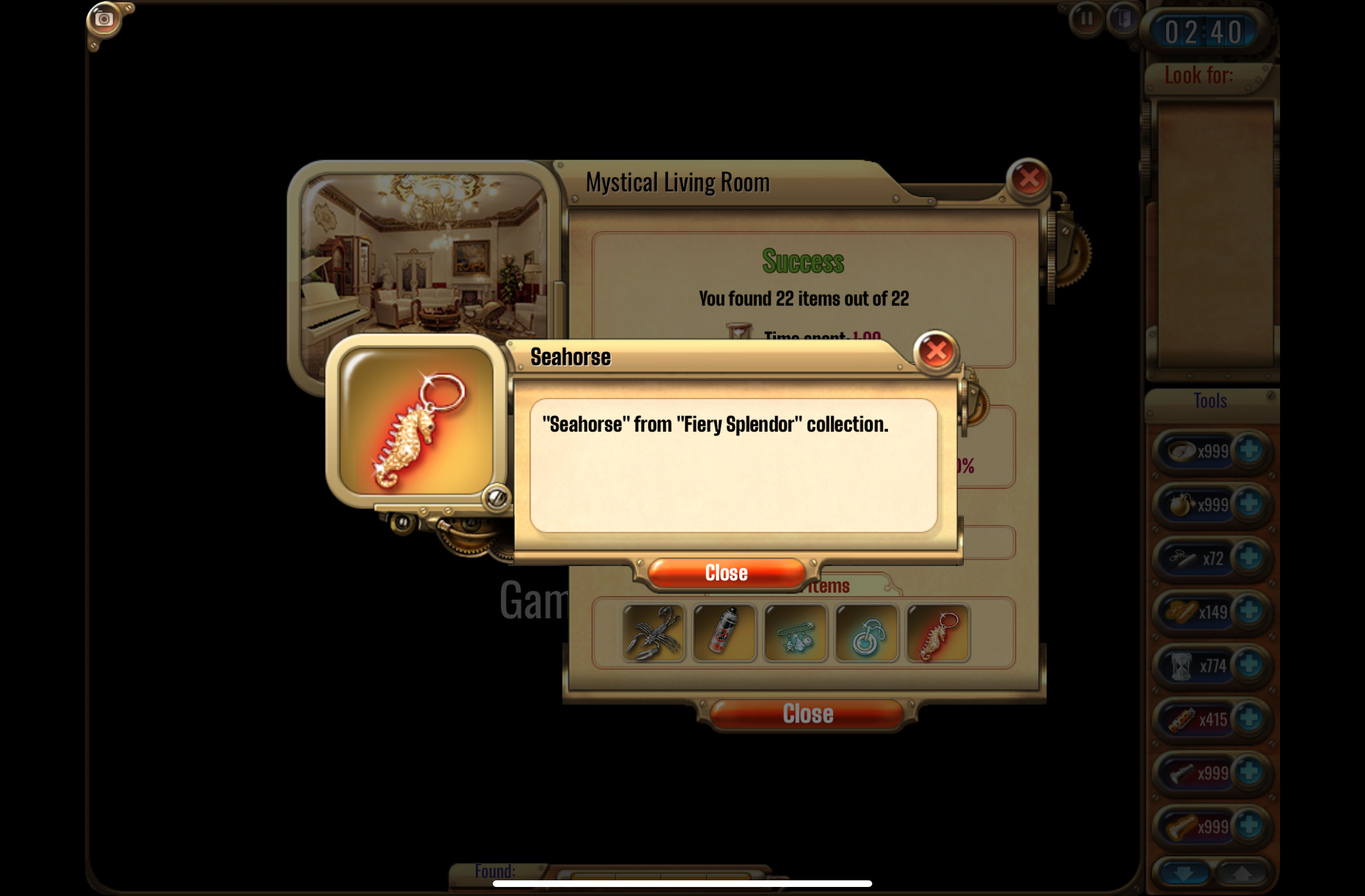
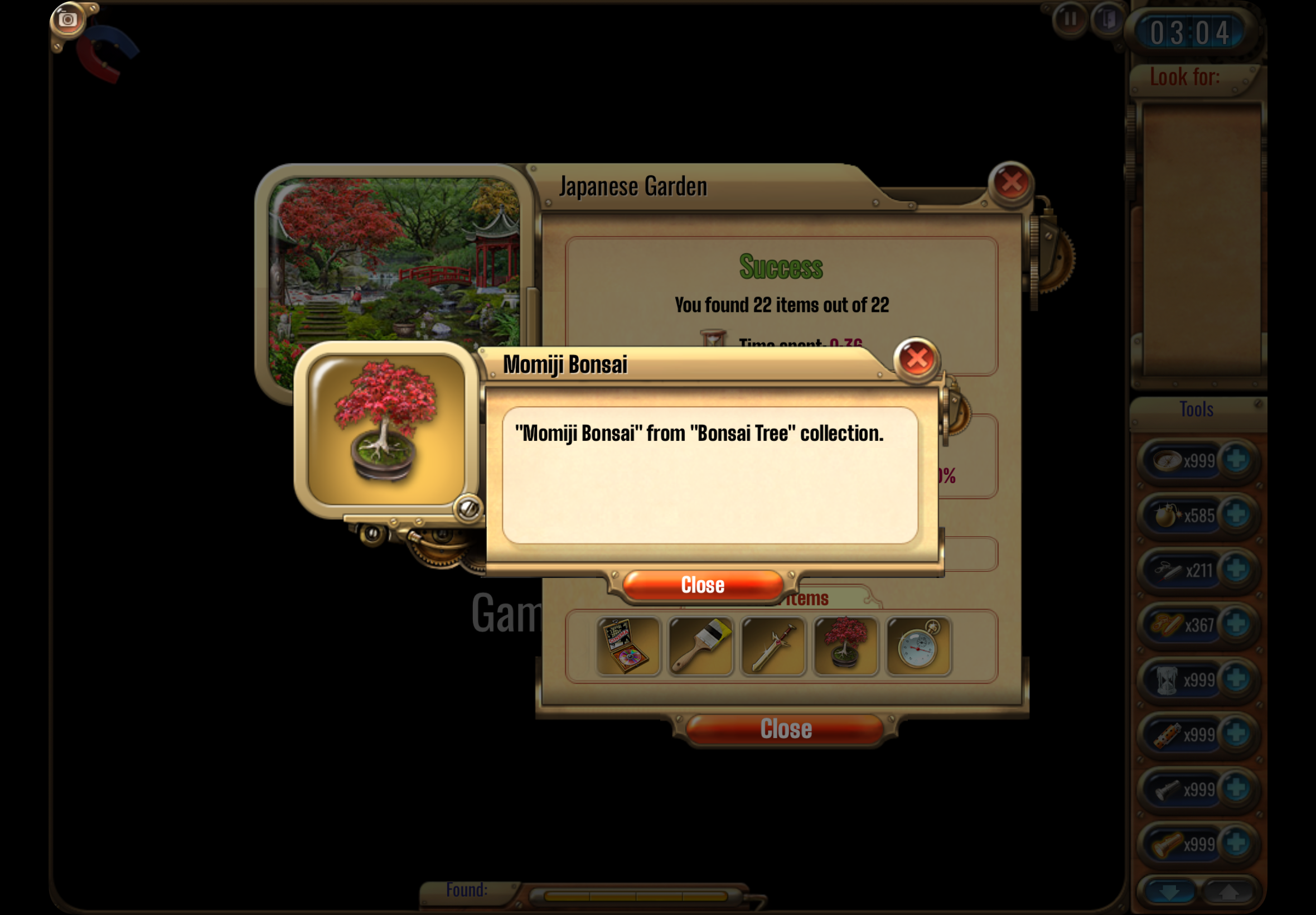
    🔹   Найти любой предмет из коллекции «Бонсаи» и сделать скриншот из выпадающего списка после прохождения комнаты. <br>
    🔹   Написать историю на тему: <br>
<b>«Каким характером обладало это дерево и почему остальные бонсаи запомнили именно его?». </b> <br>
<br> </p>

<p style="font-size: 21px;"><i>

🌿🍃 Скриншот в кармане, а ещё одна история маленького дерева стала известна миру. <br>
Возможно, именно поэтому старые садовники никогда не сравнивают бонсаи между собой. <br> Каждый из них растёт по-своему, переживает свои бури и хранит свои воспоминания. <br>
А если однажды вечером вам покажется, что в Японском саду кто-то тихонько спорит за вашей спиной, не оборачивайтесь слишком быстро. <br>
Вдруг это снова маленькие деревья обсуждают, чья история сегодня оказалась самой удивительной. 🌿✨

<br> <br></i></p>

<p style="font-size: 20px;"> <b> 📜 Условия: </b> <br>
    •    Один участник - один скрин, одна история. <br>
    •    Скрин и история публикуются в теме конкурса. <br>
    •    Оценивается оригинальность и атмосфера. </p>

<p style="font-size: 20px;"> <b> 🏆 Победитель: </b> <br>
Будут выбраны самые пылкие, интересные и креативные истории. </p>

<p style="font-size: 20px;"> <b> 🎁 Призы: </b> <br>
🍬 За участие (скриншот с подписью) — 1 коллекция №364 “Магические эликсиры” <br>
🏆 Победителю — 5 коллекций №366 «Гадальные карты» <br></p>
<p style="font-size: 20px;"> <b> 🕰 Сроки проведения: </b> <br>
📅 2 дня: 3-4 октября включительно
(с полуночи до полуночи, по московскому времени) </b> </p>

<p style="color: green; font-size: 20px;"> <b> 💚 Администраторы: 🌷Эля, ♊ Sanioka

</div>
       

        <div class="letstalk_rules" id="rules">
            <a class="close" onclick="return false;" title="закрыть">×</a>
            <div class="ruleswrapper">
                <div class="inner">
                    <p>Принять участие в этой теме очень просто просто</p>
                   <p>Читаем задание и выполняем </p>

<p>Попыток может быть несколько, но приз за участие выдается только один раз за период одного соревнования </p>

<p>Не забудьте , указать френдкод и уровень, чтобы можно было подарить подарки.</p>

                </div>
            </div>
        </div>
    </article>
<script>$(document).ready(function(){
        $('.LIKES-514').prepend('<a href="#" class="close" onclick="return false;" title="закрыть">×</a>');
   
        $('a.rating').click(function() {
            $('.LIKES-514').fadeToggle(600);
        });
   
        $('a.rules').click(function() {
            $('#rules').fadeToggle(600);
        });
   
        $('.LIKES-514 a.close').click(function() {
            $('.LIKES-514').fadeOut(600);
        });
   
        $('#rules a.close').click(function() {
            $('#rules').fadeOut(600);
        });
   
     });
    </script>[/html]

Отредактировано Sanioka (2026-09-05 00:01:38)

+17

1571

gallery

Precious Temper
The jeweler, Master Ilvo, told the duke to come back in nine days. On the tenth, the duke found him asleep at his bench among the wreckage of eight failed animals.
"A swan," Ilvo said, without opening his eyes. "The stone cracked straight down the neck. A lioness went cloudy and sulked like a cat in the rain. And a peacock." He pointed at a heap of gold feathers. "That one laughed at me, I'm fairly sure."
The duke, who could barely order soup without blushing, asked what the stone wanted.
Ilvo unfolded a velvet cloth. On it lay a seahorse no longer than a thumb, its body glowing red-gold like a small, furious sunset. A row of diamond spines ran down its back like raised eyebrows.
"A seahorse?" said the duke. "She's a princess. Not a… fish."
"Look how it stands," said Ilvo. "Everything else in the sea swims lying down. Not this one. It moves through the water upright, chin high, as if it were entering a ballroom. It can't outrun a current, so it doesn't try. It wraps its tail around something it believes in and lets the whole ocean argue with it."
The duke thought of the princess at the Spring Council, when three ministers had tried to marry her off to a margrave. She had simply smiled, held onto the arm of her chair, and outlasted them all, until the margrave went home engaged to someone's aunt.
"And the fire?" he asked.
"Seahorses change color when they feel strongly. Yours will never be pale." Ilvo coughed. "One more thing. Among seahorses, it's the gentleman who carries the family. She will lead, my lord. You will be the one holding things."
The duke considered this for the length of one held breath, then paid double.
The princess opened the case that evening by the fire. She went very still. Then she laughed, a real laugh, unladylike and enormous, which rolled through eleven rooms and woke a footman.
"It's me," she said. "Look at it. Absolutely furious and perfectly composed."
"The jeweler said it stands upright in any current," the duke managed.
"Of course it does." She hooked the chain around one finger and studied him. "And did he tell you about the gentlemen seahorses?"
The duke turned the exact color of the pendant.
"Good," said the princess, and handed him her gloves, her fan, and the empty case to hold.
They were married by midsummer. Over the next forty years he carried a great many things, and was never once sorry.
The seahorse passed through nine generations of women who wouldn't bow, and the men patient enough to stand beside them. Every owner swears the same thing: whenever a room turns unjust, the little pendant warms against the collarbone, like a tail curling tight and holding on.

https://upforme.ru/uploads/0019/3c/8c/7205/660921.png

Отредактировано Laura-LBB (2026-10-02 19:16:56)

Подпись автора

LBB 

39e8b4

Guild: Double D’s

+2

1572

https://upforme.ru/uploads/0019/3c/8c/198/t249950.png

Триста лет назад молодой герцог влюбился в княгиню, которую невозможно было удержать ни правилами, ни придворными условностями.
Она могла среди бала внезапно сбежать в сад, смеяться громче всех и спорить с самим послом, если тот говорил не то, что думал.

Герцог долго не мог решить, какой подарок ей преподнести. Наконец он пришёл к старому ювелиру и попросил создать украшение, в котором княгиня смогла бы узнать себя.

Ювелир выбрал морского конька из золота и драгоценных камней.

— Почему именно его? — спросил герцог.

— Потому что он кажется хрупким, но не боится течения, — ответил мастер. — Он плывёт своим путём и не позволяет волнам решать за него, куда направляться.

Когда княгиня увидела подарок, она долго смотрела на маленького морского конька, а потом улыбнулась.

— Вы угадали, — сказала она. — Наконец-то кто-то подарил мне не то, какой я должна быть, а ту, какая я есть.

С тех пор морской конёк стал её любимым украшением — символом её свободолюбивого, независимого и неукротимого характера.

Подпись автора

48557а

+3

1573

https://upforme.ru/uploads/0019/3c/8c/7217/t205693.png

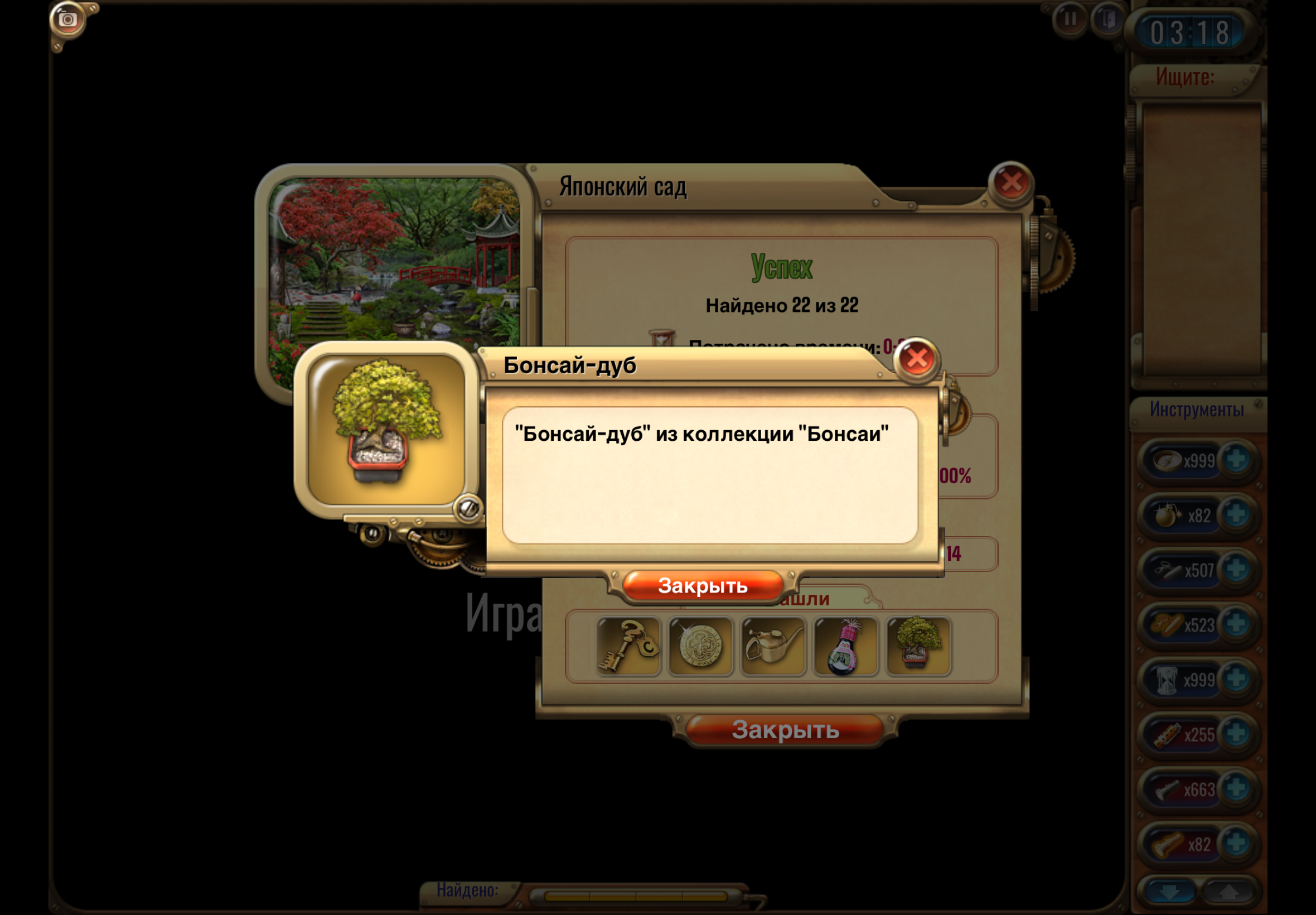
В ту ночь, когда деревья Японского сада заговорили, первым заговорил маленький дуб.
Он стоял в низкой чаше у пруда -невысокий, изогнутый ветрами, с крошечной кроной. Рядом росли изящные клёны, цветущие вишни и старые сосны. Все они считали себя красивее него.

-Посмотрите на мои листья, - шелестела вишня.

- А я пережила три столетних зимы, - гордо поскрипывала сосна.

Дуб долго молчал.

Наконец клён спросил:

- А тебе есть чем похвастаться?

Дуб тихо ответил:

- Есть.

И впервые за ночь зашумели все его листья.Дуб рассказал, что когда-то был огромным деревом в далёком лесу. Под его кроной прятались олени, на ветвях гнездились птицы, а мальчик каждый год приходил собирать жёлуди и говорил:

- Когда вырасту, построю здесь дом.

Но однажды пришла буря.Молния расколола старый дуб, и садовник нашёл среди корней маленький росток.

Он пересадил его в чашу и много лет заботился о нём.

- Значит, ты потерял свой лес? - тихо спросила сакура.

-Нет, - ответил дуб. - Я принёс его с собой.

Деревья замолчали.И тогда они заметили то, чего никогда прежде не видели: в тени маленького дуба каждое лето прорастали крошечные зелёные ростки.Жёлуди.Его лес продолжал жить.

На рассвете деревья больше не спорили, кто из них красивее. А старый садовник, проходя мимо дуба, услышал тихий шелест:

«Большому дереву нужен лес. Маленькому -память».

С тех пор остальные бонсаи запомнили дуб не за высоту и не за красоту. А за его удивительный характер:

он был маленьким деревом, которое никогда не забыло, каким огромным когда-то было его сердце.

Подпись автора

Даже тигры любят игры!
      🐅 Ррррррр! 🐅

               f1ec22

+4

1574

https://upforme.ru/uploads/0019/3c/8c/198/t679732.png

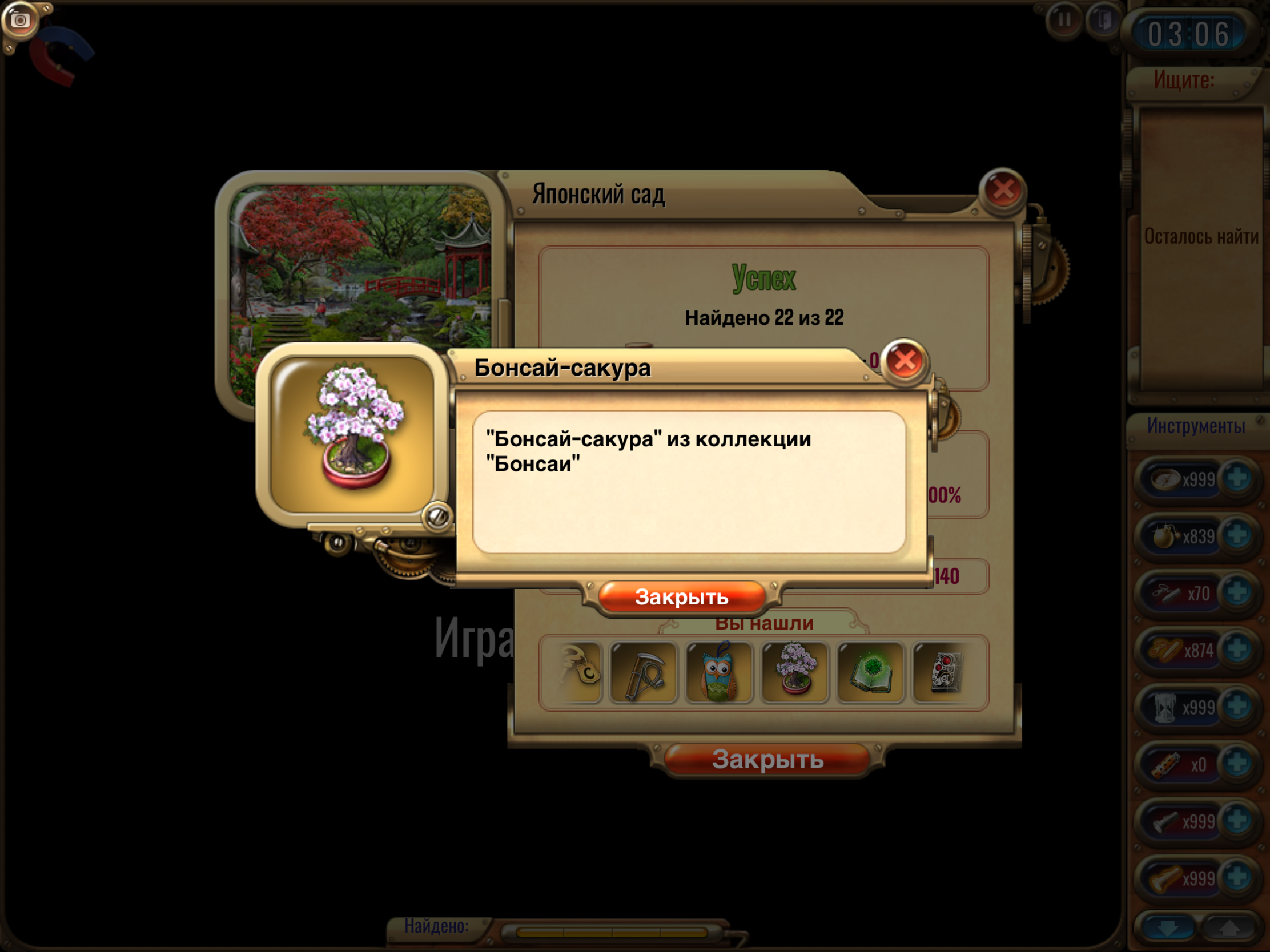
Бонсай-сакура обладала удивительно спокойным и терпеливым характером. Она никогда не спорила громче других и не старалась доказать, что именно её история самая важная.
Каждую весну она первой расцветала, но никогда не хвасталась своей красотой. А когда налетал сильный ветер и с её ветвей осыпались лепестки, сакура лишь тихо говорила:

— Всё проходит, чтобы однажды начаться снова.

Но у неё была одна странность, о которой садовники старались не говорить вслух. Каждый год ровно в полночь перед праздником фонарей на одной из её ветвей распускался единственный цветок. Он появлялся всего на несколько минут, хотя вокруг ещё не было ни одного другого цветка.

Говорили, что если в этот момент загадать желание, которое никому никогда не рассказывал, сакура обязательно его услышит.

Остальные бонсаи запомнили её именно за это спокойствие и мудрость. Пока они спорили о прошлом, сакура умела просто слушать каждого.

И в ту ночь, когда деревья наконец пришли к согласию, на её ветвях вдруг появился тот самый единственный цветок.

С тех пор её считали не только самым мудрым и добрым, но и самым загадочным деревом сада.

Подпись автора

48557а

+3

1575

https://upforme.ru/uploads/0019/3c/8c/7213/t997471.jpg

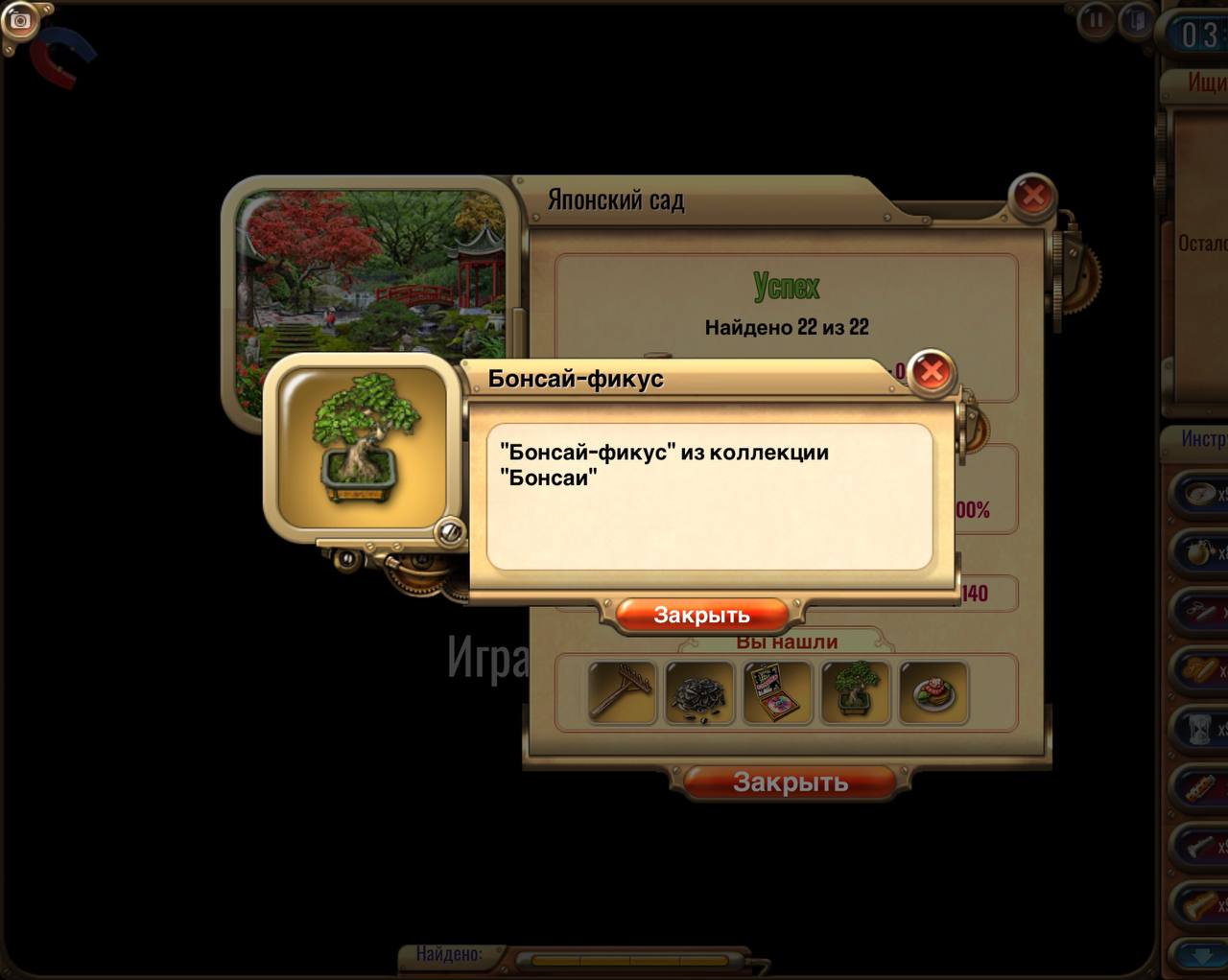
История бонсай-фикуса по имени Хару
В самом тихом уголке Японского сада, на небольшой каменной подставке возле пруда, рос бонсай-фикус по имени Хару.

Он был невысоким, с причудливо изогнутым стволом, густой кроной и маленькими блестящими листьями. На первый взгляд Хару казался самым обыкновенным деревцем. Но остальные бонсаи знали: характер у него совершенно необыкновенный.

Хару был любопытным, упрямым и удивительно доброжелательным. Он никогда не хвастался своей красотой и не спорил о том, чья крона пышнее. Зато он обожал задавать вопросы.

— Почему сосна всегда смотрит в небо?

— Зачем клёну нужны такие яркие осенние листья?

— И правда ли, что ветер знает все дороги мира?

Другие деревья сначала посмеивались над его расспросами. Но однажды в сад пришла сильная буря. Ветер раскачивал ветви, дождь заливал дорожки, а несколько молодых бонсаев испугались, что их хрупкие стволики не выдержат непогоды.

Именно Хару первым заметил, что вода из переполненного ручья направляется прямо к их подставкам.

— Не бойтесь! — позвал он. — Мы должны помочь друг другу!

Его корни крепко держались за землю, а широкая крона задерживала порывы ветра. Хару не мог остановить бурю, зато сумел привлечь внимание садовника: его гибкие веточки стучали по бамбуковому ограждению, пока тот не услышал необычный сигнал.

Садовник поспешил в сад, отвёл воду и перенёс самые маленькие деревца в безопасное место.

Когда буря закончилась, остальные бонсаи благодарили Хару. Но он лишь улыбнулся листьями:

— Я просто заметил то, чего другие не заметили. А спаслись мы все вместе.

С той ночи деревья стали смотреть на фикус иначе. Они поняли, что за его любопытством скрывается внимательное сердце, за упрямством — стойкость, а за весёлым нравом — настоящая забота о других.

И когда в следующую ночь перед праздником фонарей бонсаи снова собрались поспорить, чья история интереснее, сосна неожиданно сказала:

— Давайте послушаем Хару. Он всегда замечает то, мимо чего мы проходим.

Фикус немного смутился, поправил листочек и начал рассказывать о том, как однажды видел крошечную лягушку, которая пыталась перепрыгнуть через дорожку из камней.

Деревья слушали до самого рассвета, смеялись и удивлялись.

С тех пор бонсай-фикус Хару запомнили не за необычную форму ствола и не за красоту листьев, а за редкий дар: он умел находить удивительные истории в самых обыкновенных вещах и напоминал всем, что настоящая сила дерева заключается не только в крепких корнях, но и в добром сердце.

https://upforme.ru/uploads/0019/3c/8c/7213/303465.png
6b0f91

Подпись автора

Уровень 250;  6b0f91

+2

1576

Adventure Quest.  Japanese Garden - The Great Debate of Little Trees
https://i.imgur.com/AlGezwgm.png

🌿🍃 "THE GREAT DEBATE OF LITTLE TREES"
📍  Japanese Garden
🌿🌺🌳 There is an old legend in the Japanese Garden that the gardeners tell only to guests patient enough to notice things other people miss.

They say that once every year, on the night before the Lantern Festival, when the gates are locked and the last gardener has gone home, the trees begin to talk.

Usually, they are quite dignified about it.

Usually .

One year, however, an argument broke out among the bonsai.

The little pine started it by announcing that no tree in the garden had a more interesting history than he did.

"I have survived drought, frost, three repottings, and a gardener who once sneezed while holding pruning shears."

The juniper immediately objected.

"I have spent eighty-seven years growing sideways off a rock."

"That's not a story," muttered the azalea. "That's poor planning."

Soon every tree was talking at once.

One boasted of the storms it had survived. Another insisted beauty was more important than endurance. A third reminded everyone that its ancestors had grown on distant mountains long before anyone thought of putting trees into decorative pots.

The argument continued through most of the night.

Then, just before dawn, something extraordinary happened.

They agreed .

Not about  which tree had the best story —that would have required several more centuries—but that perhaps the most interesting stories did not have to be alike.

Ever since, the gardeners say, every bonsai in the Japanese Garden has been regarded as having its own personality, memories, peculiarities and, occasionally, an ego entirely too large for its pot.

And among them, one little tree was remembered particularly well.

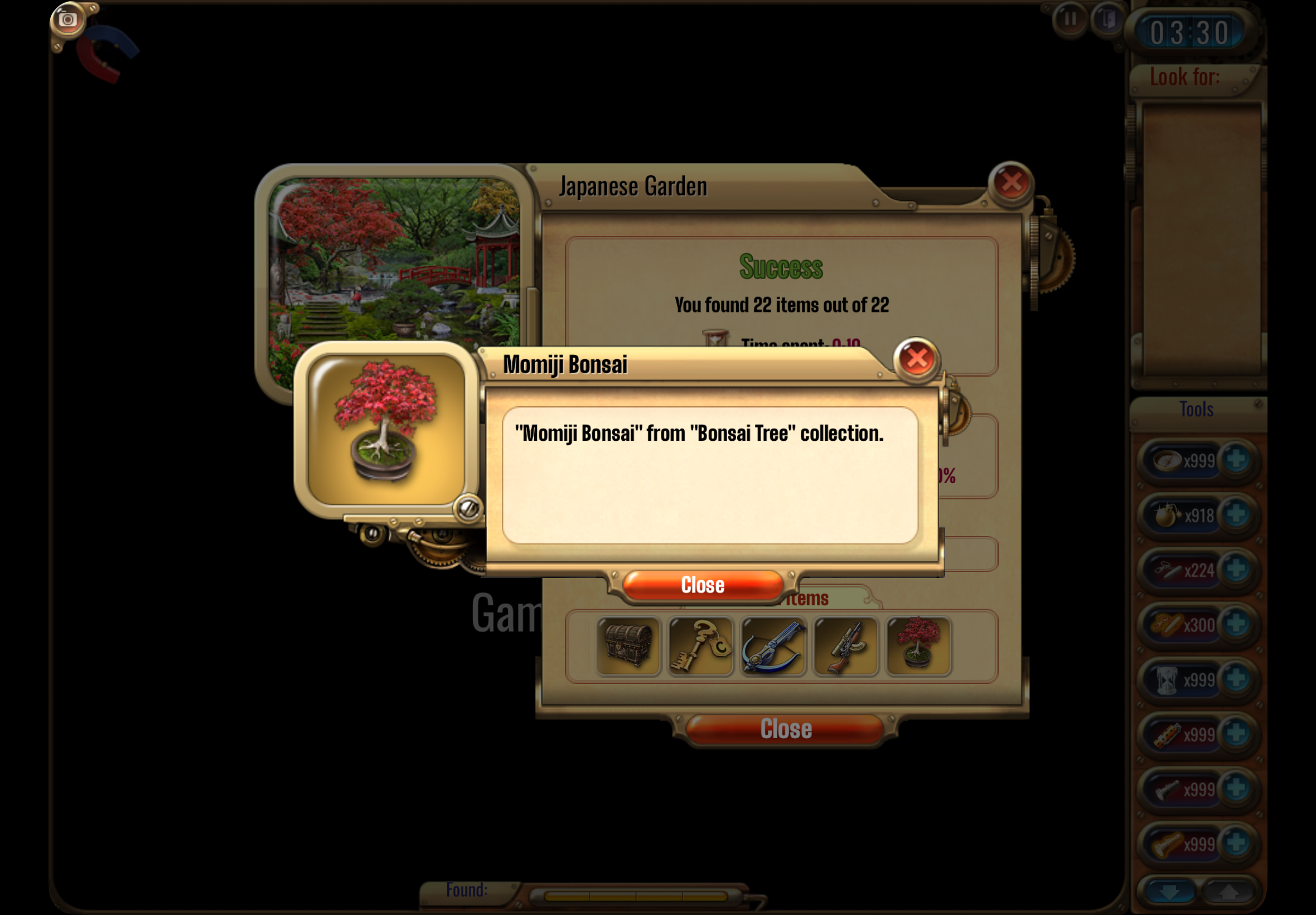
The  FOUND Momiji Bonsai .

🍁🌳✨

The Momiji was a Japanese maple, and the first thing everyone noticed about him was that he did not look especially formidable.

He had no enormous trunk .

No intimidating thorns .

No massive branches .

Even his leaves looked delicate—small, graceful, divided into slender points that fluttered whenever the breeze passed through the garden.

The pine took one look at him and whispered to the juniper:

"That one wouldn't survive a serious storm."

The Momiji heard him .

"Probably not," he replied cheerfully. "I'll survive an  interesting  one."

That was the Momiji's character.

He refused to confuse  strength with stiffness .

When the heavy wind swept through the garden, the pine braced itself.

The juniper resisted .

The Momiji bent.

His slender branches twisted, trembled and yielded so dramatically that the other bonsai were certain he was about to be scattered across the garden.

Then the wind stopped.

The Momiji straightened himself.

"Is everyone still here? "

The pine grumbled, "You nearly bent in half."

"Yes. "

"You call that strength? "

"No," said the Momiji. "I call it avoiding unnecessary paperwork."

The azalea laughed so hard she dropped a blossom.

There was some truth behind his philosophy. Japanese maple is valued less for brute, heavy strength than for its fine-grained wood and graceful form; the living tree's relatively flexible branches also suit the careful shaping required in bonsai. The Momiji therefore had no intention of competing with larger trees over who possessed the toughest timber.

"If somebody needs a bridge," he once said, "I strongly recommend they look elsewhere."

But the Momiji possessed another kind of strength.

He could  change without becoming something else .

Spring dressed him in tender new leaves.

Summer deepened them into green.

Then autumn arrived .

And the little tree exploded.

Scarlet .

Crimson .

Orange .

Gold .

The other bonsai stared .

Even the pine—who considered changing one's appearance every season evidence of an unstable personality—was impressed.

Momiji and Japan's autumn colors have been admired for centuries. The tradition of  momijigari , going out specifically to appreciate autumn foliage, reaches back to Japan's Heian period; maple leaves became associated with seasonal beauty, poetry and contemplation.

The Momiji, naturally, had his own interpretation.

"Observe," he announced as his leaves turned brilliant red, "how gracefully I accept change."

"You've been talking about your leaves for six days," said the juniper.

"Gracefully  and loudly . "

Then came the morning when his first red leaf fell.

The pine chuckled .

"You're losing your famous wardrobe."

The Momiji watched another leaf drift gently onto the moss.

"Correct. "

"Doesn't that bother you?"

"No. "

"You're going to lose all of them."

"I know. "

"And you'll stand there completely bare."

The Momiji considered this.

"Could you perhaps announce it a little louder? I don't think the bamboo heard you."

The bamboo rustled from across the pond.

"I HEARD. "

That was when the other bonsai began to understand him.

The Momiji's greatest talent wasn't his autumn color.

It was his complete lack of fear that the color would disappear.

Every year he surrendered everything that made visitors stop and admire him.

Every year he stood through winter with nothing but branches.

And every spring he began again.

The gardeners who visited the garden saw beautiful seasonal transformation. The bonsai saw something else: a tree perfectly willing to lose yesterday's glory because he trusted tomorrow's growth. Japan's long tradition of admiring autumn leaves similarly connects their changing colors with reflection on nature and the passing seasons.

Of course, none of this made the Momiji humble.

Quite the opposite.

Whenever visitors crowded around him in autumn, he would whisper to the pine:

"Another admirer. "

"They're looking at the pond."

"They're pretending. "

"They're photographing the bridge."

"Composition. I'm obviously the emotional center."

Then one autumn evening a tremendous storm struck the Japanese Garden.

Rain hammered the lanterns.

Wind tore through the branches.

The pine stood rigid .

The juniper clung stubbornly to its shape.

The little Momiji bent so far that his branches nearly touched the rim of his pot.

"Still think bending is strength?" shouted the pine over the wind.

A violent gust struck .

CRACK !

One of the pine's small branches snapped.

There was a moment of silence.

Then, from somewhere close to the ground, came the Momiji's voice.

"I would make a joke about that..."

"Don't. "

"...but I wouldn't want to  branch off  into inappropriate humor."

"Momiji."

"I suppose that one didn't  stick ."

"MOMIJI."

The azalea began laughing.

By morning, the storm was gone.

The little maple slowly lifted his branches towards the sunlight.

He had lost leaves .

He had been bent nearly double.

He looked thoroughly bedraggled.

But he was still there .

The pine was treated differently after that.

"So," he finally said, "perhaps there are several kinds of strength."

The Momiji shook rainwater from his remaining leaves.

"I've been trying to tell you that."

"You mostly told jokes. "

"I was trying to make the lesson memorable."

It worked .

Years passed, and many bonsai entered the garden. Some were older than the Momiji. Some were rare. Some possessed magnificent trunks that made visitors stop immediately.

But the other little trees always remembered the maple.

Not because he was the strongest.

Not because he was the oldest.

And not even because every autumn he dressed himself in enough crimson to behave as though the entire season had been organized in his honor.

They remembered him because the Momiji had taught them something that sounded suspiciously sensible for a tree that made so many terrible jokes:

Being strong doesn't always mean refusing to bend.
Sometimes it means bending, changing, losing something precious—and still being ready to grow again.

And that, according to the old gardener who claimed to have overheard everything, was the night the Great Debate of the Little Trees finally ended.

At least temporarily .

Because five minutes later the pine asked:

"Nevertheless, who do we agree has the most impressive trunk?"

And the argument started all over again.

🌿🍃📸  So another screenshot goes into your pocket, carrying with it a little tree's story that might otherwise have remained only a whisper in the garden.

Perhaps that explains why experienced gardeners are reluctant to declare one bonsai better than another. Every little tree follows a different path, bends beneath different storms and keeps memories that belong to it alone.

And should you someday wander through the Japanese Garden near evening and hear faint voices debating somewhere behind you, resist the temptation to turn around immediately.

It may only be the bonsai holding another meeting.

After all, they still haven't settled the question of whose story was the most remarkable.

And knowing the Momiji, he is probably demanding a recount. 🌿🍁✨

https://i.imgur.com/H4uICJQ.jpeg

+1

1577

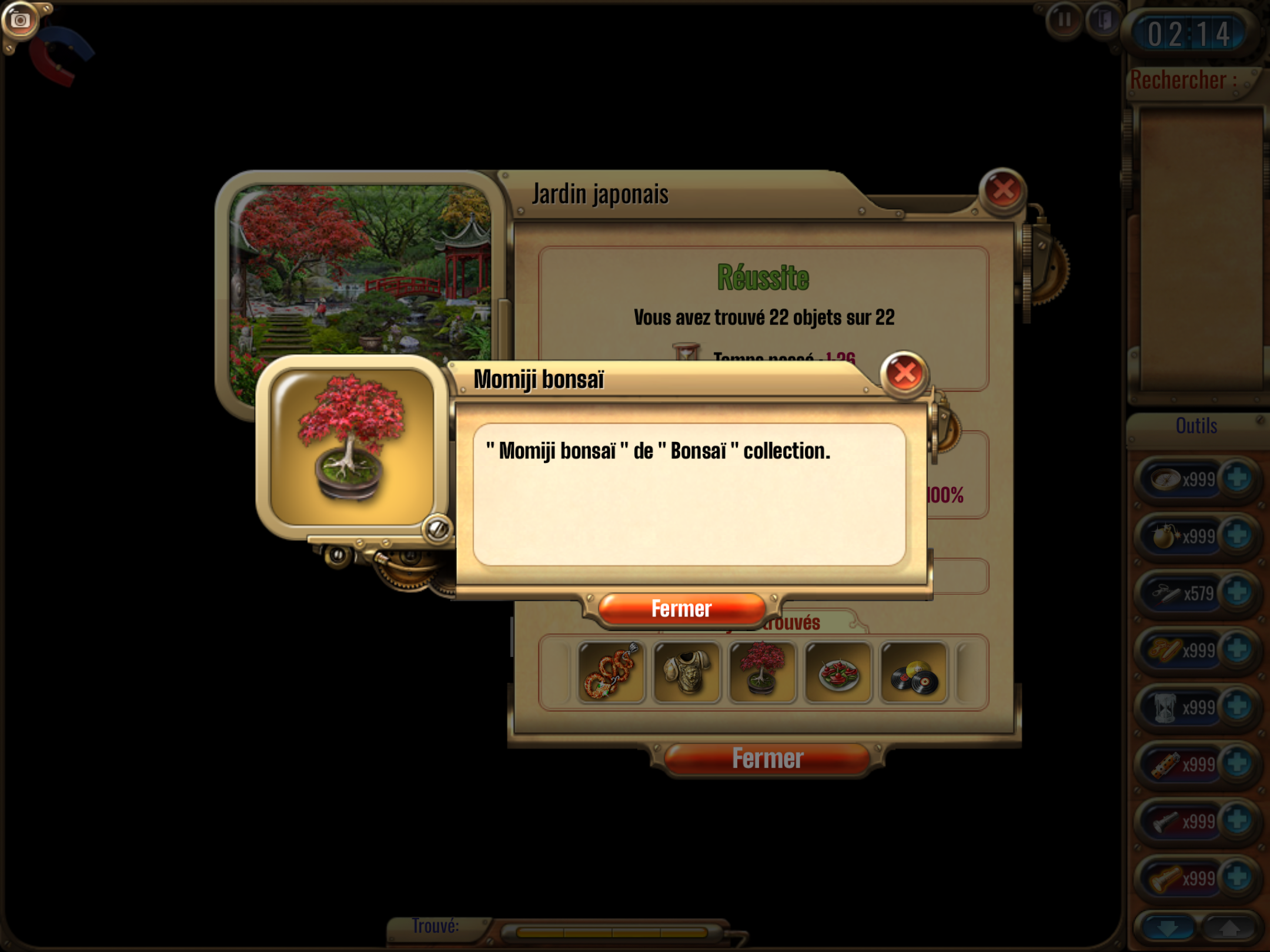
Quête https://upforme.ru/uploads/0019/3c/8c/7219/t400608.pngJardin japonais

C'était une nuit de velours noir, celle qui précédait la fête des lanternes. Dans le grand jardin japonais de Kyoto, le vent s'était tu, laissant place à un silence vibrant. Puis, à minuit pile, le miracle annuel se produit : une vibration douce parcourut la mousse fraîche, et les bonsaïs se mirent à converser.

Parmi les azalées miniatures et les genévriers centenaires, tous les regards - ou plutôt toutes les cimes - se tournèrent vers le centre du jardin. Là, sur un piédestal de pierre brute, trônait un espace vide. L'arbre qui l'occupait autrefois n'était plus là, mais son souvenir hantait le jardin.

Il s'appelait Shinju, un Érable du Japon ( Momiji ) au tronc tortueux et aux feuilles de sang.

Les autres bonsaïs se souvenaient de lui avec un mélange de terreur sacrée et d'admiration absolue, car Shinju possédait un caractère unique : il était incendiaire, rebelle et d'une passion dévorante.

Alors que la philosophie du bonsaï exige la soumission à la main du maître, la patience et le calme, Shinju, lui, bouillonnait de vie. Il refusait de se laisser domestiquer. Chaque fois que le vieux maître jardinier tentait de poser des fils de cuivre pour pincer ses branches selon le style traditionnel  Moyogi , Shinju brisait les fils pendant la nuit par la seule force de sa sève. Il ne voulait pas être une imitation de la nature ; il voulait être la nature elle-même, sauvage et indomptable.

« Vous rappelez son automne d'anthologie ? " murmura un vieux pin noir, la voix rauque de résine. « Normalement, nous changeons de couleur avec retenue. Lui... il est devenu si rouge, d'un écarlate si violent, qu'on aurait dit qu'il brûlait de l'intérieur. Le maître a passé des nuits entières à le surveiller, fasciné par cette rage de vivre. "

Mais ce que les arbres n'oublieraient jamais, c'est le grand sacrifice de Shinju, survenu trois ans plus tôt, précisément la nuit précédant la fête des lanternes.

Cette nuit-là, un incendie s'était déclaré dans le pavillon de thé adjacent. Les étincelles volaient, poussées par un vent soudain, menaçant de réduire en cendres tout le jardin de bonsaïs, prisonniers de leurs pots et incapables de fuir. Shinju, déployant une énergie surhumaine, insuffla toute sa sève dans ses branches supérieures et projeta un écran de feuilles d'un rouge incandescent pour intercepter les braises. Il fait barrage de son propre corps miniature pour protéger ses frères d'écorce.

Le lendemain, le feu fut éteint, le jardin était sauvé, mais Shinju était calciné. Le maître, en larmes, comprit le geste de son arbre rebelle. Au lieu de le jeter, il décide de sculpter son bois mort selon la technique du  Tanuki , immortalisant sa silhouette héroïque au cœur du temple du jardin.

"Il n'était pas un arbre de salon", chuchota un jeune ficus, ému. « Il nous a appris qu'un bonsaï n'est pas un prisonnier dans un pot de terre, mais un géant qui a choisi de concentrer toute la grandeur de l'univers dans un espace minuscule. "

C'est alors que, dans le silence suspendu de cette nuit sacrée, deux silhouettes se faisant face sur les étagères de bois sombre réprirent le fil de la discussion.

D'un côté, le Vieux Pin Noir, baptisé Matsu. Son écorce était si épaisse et crevassée qu'elle se trouvait à la roche. Ses aiguilles, d'un vert sombre et rigide, défiaient les siècles. De l'autre côté, une jeune Azalée Satsuki, nommée Suki, aux branches encore souples et au feuillage tendre, presque timide face à l'immensité de son voisin.

L'écho de la vie de Shinju flottait encore dans l'air frais.

- « Je ne comprends pas, Matsu-san », murmura la jeune azalée, faisant frémir ses quelques bourgeons précoces. «Le maître passe ses journées à nous tailler, à guider nos branches avec tant de douceur. Pourquoi Shinju ressentait-il cette rage ? N'est-ce pas une bénédiction que d'être aimés et protégés dans ce jardin ? "

Le vieux pin laissa échappe à un soupir qui fait bruisser ses aiguilles comme un vent de montagne.

- "Petite Suki... Tu as la chance d'être née pour fleurir. Le maître attend de toi la beauté, la couleur, la délicatesse. Mais Shinju était un érable. Dans ses gènes coulait le sang des forêts sauvages de l'île d'Hokkaido. Pour lui, le pot n'était pas un bouclier contre le monde, c'était une cage. Son amour pour le maître était un combat quotidien entre la gratitude et le besoin viscéral d'absolu. "

— « Mais s'opposer au fil de cuivre... se rebeller jusqu'à en saigner de la sève... n'est-ce pas rejeter l'art du bonsaï lui-même ? » demanda Suki, une pointe d'effroi dans sa voix de sève douce.

Matsu tourne lentement sa cime vers l'emplacement vide de l'érable.

— «C'est là toute la beauté de notre existence, ma jeune amie.» Regarde-moi. J'ai deux cents ans. J'ai accepté chaque fil de fer, chaque torsion. J'ai plié mon dos pour ressembler au vent de l'océan. J'ai choisi la voie de l'harmonie par la soumission. C'est le chemin de la longévité. Mais Shinju... Shinju a choisi la voie de la ferveur. Il n'a pas cherché à vivre longtemps, il a cherché à vivre intensément. "

- « Et pourtant, il est mort pour nous sauver », réalisation Suki dans un souffle. « Sa rébellion n'était pas de la haine. "

- "Précisément", répondit le vieux pin, et son écorce semble s'adoucir sous la lueur de la lune. « Sa passion n'était pas dirigée contre le jardin, elle était le moteur de son être. C'est parce qu'il aimait ce lieu avec une fureur sauvage qu'il a pu transformer son corps en bouclier de feu. Sans sa rébellion, il n'aurait jamais eu la force de briser son pot pour déployer ses branches cette nuit-là. "

Suki resta silencieuse un long moment. Elle regardait ses propres branches, si droites, si parfaites. Pour la première fois de sa vie, elle laissa l'une de ses tiges se cambrer légèrement vers la lumière, s'écartant imperceptiblement de la ligne parfaite que le maître lui avait tracée la veille.

- « Je crois que je comprends », chuchota-t-elle. "Cette année, Matsu-san... je ne fleurirai pas seulement pour être jolie. Je fleurirai avec un peu de sa fureur. "

Le vieux pin sourit à travers le bruissement de ses aiguilles. Au loin, la première lueur de l'aube pointait, et le grand silence de l'année s'apprêtait à retomber sur le jardin, alors que les premières lanternes de papier commençaient à s'allumer dans le ciel de Kyoto. Les arbres se sont remis au silence, porteurs d'une sève nouvelle, plus forte et plus fièrement, marqués à jamais par l'esprit de l'érable flamboyant.
Merci 🥰

Подпись автора

Mamie code 667a2c

+1

1578

https://i.imgur.com/KCGsPqim.jpeg

В Японском саду, в укромном уголке, где утренний туман стелется по камням, рос бонсай-момидзи — маленький клён с листьями, будто вырезанными из закатного неба. Он был не самым высоким, не самым раскидистым, и поначалу другие бонсаи едва замечали его среди своих величественных собратьев.
Сосна с изогнутыми ветвями гордилась тем, что помнит сто штормов. Фикус шептал о далёких южных землях, откуда когда-то прибыл его предок. Даже скромный можжевельник мог рассказать про зиму, когда его почти скрыло под снегом, а он всё равно тянулся к свету. А момидзи… он почти ничего не говорил о себе. Он слушал.

Когда деревья в ту самую ночь перед праздником фонарей завели свой привычный спор — кто пережил больше, кто красивее, кто древнее, — момидзи не стал перебивать. Он только тихо вздыхал, и его листья чуть дрожали, словно от сдерживаемой улыбки.

— А ты что скажешь? — не выдержал в какой-то момент старый можжевельник, устав от собственного рассказа.

Момидзи чуть наклонил ветви и тихо ответил:

— Я помню не бури и не дальние страны. Я помню мгновения. То, как капля росы повисает на кончике листа и висит целую вечность, прежде чем упасть. Как тень от фонаря ложится на дорожку ровно в семь шагов. Как ребёнок, впервые увидевший сад, замирает и шепчет: «Он живой». Я помню тишину между словами и свет, который появляется, когда кто-то наконец понимает что-то важное.

Деревья замолчали. Сосна перестала хвастаться штормами, фикус — далёкими берегами. Они вдруг почувствовали, что в этих маленьких, почти незаметных мгновениях тоже живёт целая история.

И тогда момидзи добавил:

— Мы все храним разное. Кто-то — силу, кто-то — путь, кто-то — память о ветре. А я храню мгновения, чтобы, когда сад станет слишком шумным, кто-нибудь мог остановиться и услышать тишину.

Рассвет мягко коснулся сада, и спор утих сам собой. Деревья не стали спорить, чья история важнее. Но с той ночи все бонсаи запомнили момидзи. Не за громкие подвиги, а за то, что он умел видеть и беречь самое хрупкое — мгновение, в котором прячется настоящее чудо.

С тех пор, если гость задерживается у момидзи чуть дольше, чем у других деревьев, садовники улыбаются и говорят: «Он учит слушать сад. А сад, если его слушать, рассказывает самое главное».

Подпись автора

4ef1c7  kujo  426

+2

1579

gallery

🌿🍃 THE GREAT DEBATE OF LITTLE TREES
PART ONE — DeNae: We Had Mochi Reservations

There are certain phrases I should have learned not to trust.

“Quick little task.”

“Just take a look around.”

“It’s probably nothing.”

And Tara’s personal favorite:

“We have plenty of time before food.”

We did not have plenty of time before food.

We never have plenty of time before food.

Yet somehow, at three o’clock on Saturday afternoon, I was following my sister through the Japanese Garden at the Mystery House while she insisted our newest assignment would take “twenty minutes, tops.”

At four, we had reservations for the Lantern Tea.

Not ordinary tea.

Special Lantern Festival tea.

There were dumplings.

There were tiny sandwiches.

There were honey cakes.

And, according to the little menu Tara had been carrying around in her purse for three days, there were six different kinds of mochi.

I had already chosen mine.

Twice.

“This,” I informed her, “is not becoming another Fitness Room Brunch Situation.”

“That was completely different.”

“We missed brunch.”

“There were gremlins.”

“You said twenty minutes.”

“They stole the muscle shirt.”

“And now you’re saying twenty minutes again.”

Tara stopped walking.

“That feels unnecessarily judgmental.”

“It’s historically accurate.”

She pointed toward a wooden sign beside the path.

BONSAI COLLECTION →

“See? We find the tree, write down something profound about its personality, and leave.”

“Before four.”

“Absolutely.”

“No portals.”

“Obviously.”

“No enchanted objects.”

“Agreed.”

“No dead people.”

“DeNae.”

“I’m establishing boundaries.”

Tara sighed.

“Fine. No dead people.”

The Mystery House heard her.

I know this because somewhere behind us, a wind chime rang.

There was no wind.

We both slowly turned.

Nothing.

Tara looked back at me.

“I hate when it does that.”

“So stop challenging it.”

⸻

The Japanese Garden was beautiful.

Suspiciously beautiful.

The stone path curved between crimson maples and golden ginkgo trees. Lanterns hung from dark wooden posts. A little arched bridge crossed a pond where enormous koi glided beneath floating leaves like they owned the property.

Which, frankly, they probably did.

The deeper we walked into the garden, the quieter everything became.

No visitors.

No gardeners.

No distant sounds from the Mystery House.

Just the soft tap of bamboo.

Water moving over stones.

And every few moments—

A whisper.

I stopped.

“Tara.”

“I heard it.”

Something rustled behind us.

Then a tiny voice said:

“She has terrible posture.”

I turned around.

Nobody.

Another voice answered.

“At least she isn’t wearing those shoes.”

I looked down at my shoes.

“Tara.”

She was staring at a row of miniature trees.

Five bonsai sat on individual stone pedestals.

One twisted pine.

One flowering cherry.

One maple glowing bright red.

One juniper with branches curling like green smoke.

And one tiny, crooked tree at the very end.

The crooked one had almost no leaves.

It looked—

Well.

Grumpy.

That is the only possible description.

Its trunk bent sharply sideways, straightened again, and then bent in the opposite direction as though it had spent its entire life refusing instructions.

A tiny wooden plaque stood beneath it.

The writing had nearly faded away.

Tara leaned closer.

“Can you read that?”

“Barely.”

I rubbed some dirt from the plaque.

Two words appeared.

MASTER KENZO

Tara smiled.

“Oh, he has a name.”

The bonsai said:

“Obviously.”

We froze.

I looked at Tara.

Tara looked at me.

The tree rustled.

“Do stop gawking.”

I backed up.

“No.”

Tara whispered, “Did the bonsai just talk?”

“No.”

“You heard it.”

“I have decided I did not.”

The cherry bonsai giggled.

Actually giggled.

The maple whispered:

“She always does this.”

The pine replied:

“Denial is her first response.”

“WHO ARE YOU PEOPLE?”

Every bonsai went silent.

Tara slowly turned toward me.

“You just yelled at shrubbery.”

“I am aware.”

Master Kenzo rustled his few leaves.

“Technically, we are trees.”

“Technically,” I said, “you are six inches tall.”

There was a horrified gasp from the entire bonsai collection.

Tara grabbed my arm.

“DeNae!”

“What?”

“You insulted them.”

“I stated a measurement.”

The juniper muttered:

“Tall-tree arrogance.”

“I AM FIVE FOOT—”

Tara clapped a hand over my mouth.

“No fighting with the magical vegetation.”

Master Kenzo made a sound that I swear was a chuckle.

Then he said:

“She’ll do.”

I removed Tara’s hand.

“I’ll do for what?”

Nobody answered.

Instead, every lantern in the garden went out.

One.

Two.

Three.

All the way down the path.

Darkness rolled toward us.

Then the little stone lantern beside Master Kenzo suddenly blazed blue.

The bonsai began arguing.

All at once.

“I survived the Great Storm!”

“You mention that every year!”

“My blossoms inspired a princess!”

“She was eight!”

“My ancestors crossed the sea!”

“Your ancestors were carried in a pot!”

“That still counts!”

Tara’s eyes widened.

“The legend.”

“What legend?”

“The trees argue the night before the Lantern Festival.”

“It is three fifteen in the afternoon.”

The pine bonsai said:

“Not anymore.”

Uh-oh.

The blue flame flared.

The garden disappeared.

⸻

I landed face-first in moss.

“Tara?”

“I’m here.”

“Are you alive?”

“Yes.”

“Good.”

I lifted my head.

Then immediately wished I hadn’t.

The garden was still there.

But it wasn’t our garden.

The stone path looked new.

The bridge was freshly painted.

Hundreds of paper lanterns hung overhead.

People in beautiful robes moved along the paths carrying baskets and flowers.

Somebody walked past us holding a wooden tray piled with steaming dumplings.

Tara stared at him.

Then at me.

Then back at him.

“Oh no.”

“What?”

She pointed toward the bonsai terrace.

Master Kenzo stood there.

Except he wasn’t tiny.

He was enormous.

A full-sized ancient pine twisted over a rocky hillside, its branches spreading across the garden.

Beneath it stood a young gardener arguing with three officials.

And every single tree around us was whispering.

Loudly.

“We went back in time,” Tara said.

“Yes.”

“How far?”

“No idea.”

“The tea starts at four.”

I looked at her.

“We are currently standing in somebody else’s century.”

“I’m still hoping clocks work differently.”

The massive tree rustled.

Master Kenzo’s voice rolled across the garden.

“They’re coming.”

The other trees went silent.

The young gardener looked toward the road.

“What’s coming?” Tara whispered.

Then we heard it.

Hooves.

Shouting.

And a bell ringing somewhere beyond the garden wall.

People began running.

The officials scattered.

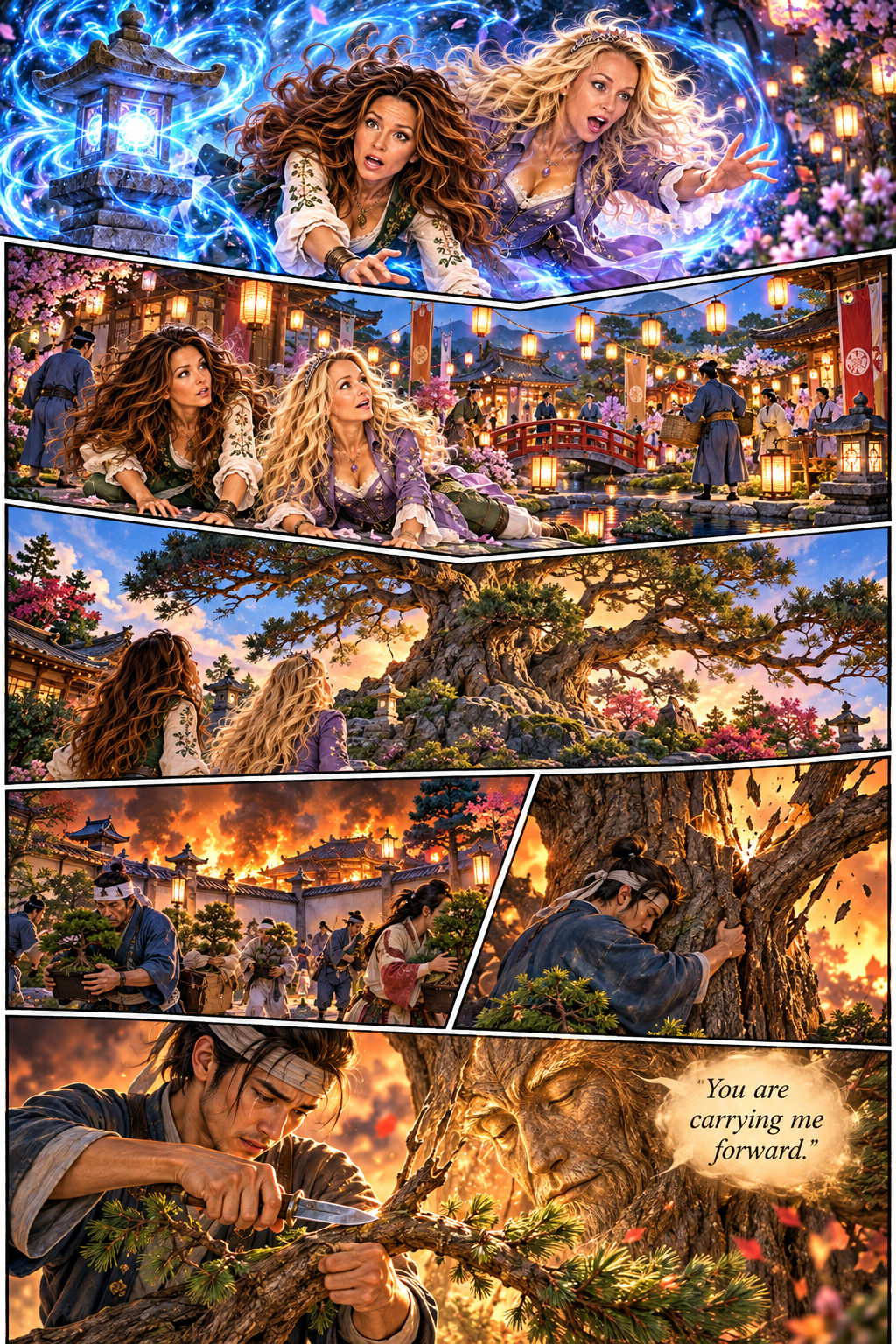
The gardener climbed onto the stone terrace and wrapped both arms around Master Kenzo’s trunk.

“No,” he whispered.

The tree answered him.

“You cannot save everything.”

Tara moved closer.

“What’s happening?”

Before I could answer, the sky flashed.

Not lightning.

Fire.

Beyond the garden wall, an orange glow rose over the rooftops.

Smoke curled into the sky.

The gardeners began carrying trees away.

Not all of them.

Only the smallest ones.

Bonsai.

One after another.

And suddenly I understood.

Master Kenzo had not always been small.

He had once towered over the entire garden.

Tara grabbed my hand.

“DeNae.”

“I know.”

The old tree bent in the wind.

Then one of its great branches cracked.

The sound echoed through the garden.

People screamed.

The young gardener pulled something from his robe.

A small silver knife.

He cut a single living branch from Master Kenzo.

Carefully.

Gently.

Then wrapped it in cloth.

The enormous tree whispered:

“Take it.”

The gardener was crying.

“I won’t leave you.”

“You are not leaving me.”

Another explosion shook the ground.

Master Kenzo’s branches trembled.

“You are carrying me forward.”

The gardener pressed the cutting to his chest.

And ran.

The world erupted in blue light.

⸻

We were back.

I was sitting on the stone path.

Tara was beside me.

The bonsai terrace stood exactly as it had before.

Five little trees.

And Master Kenzo.

Tiny.

Crooked.

Stubborn.

Alive.

For several seconds, neither of us spoke.

Then Tara quietly said:

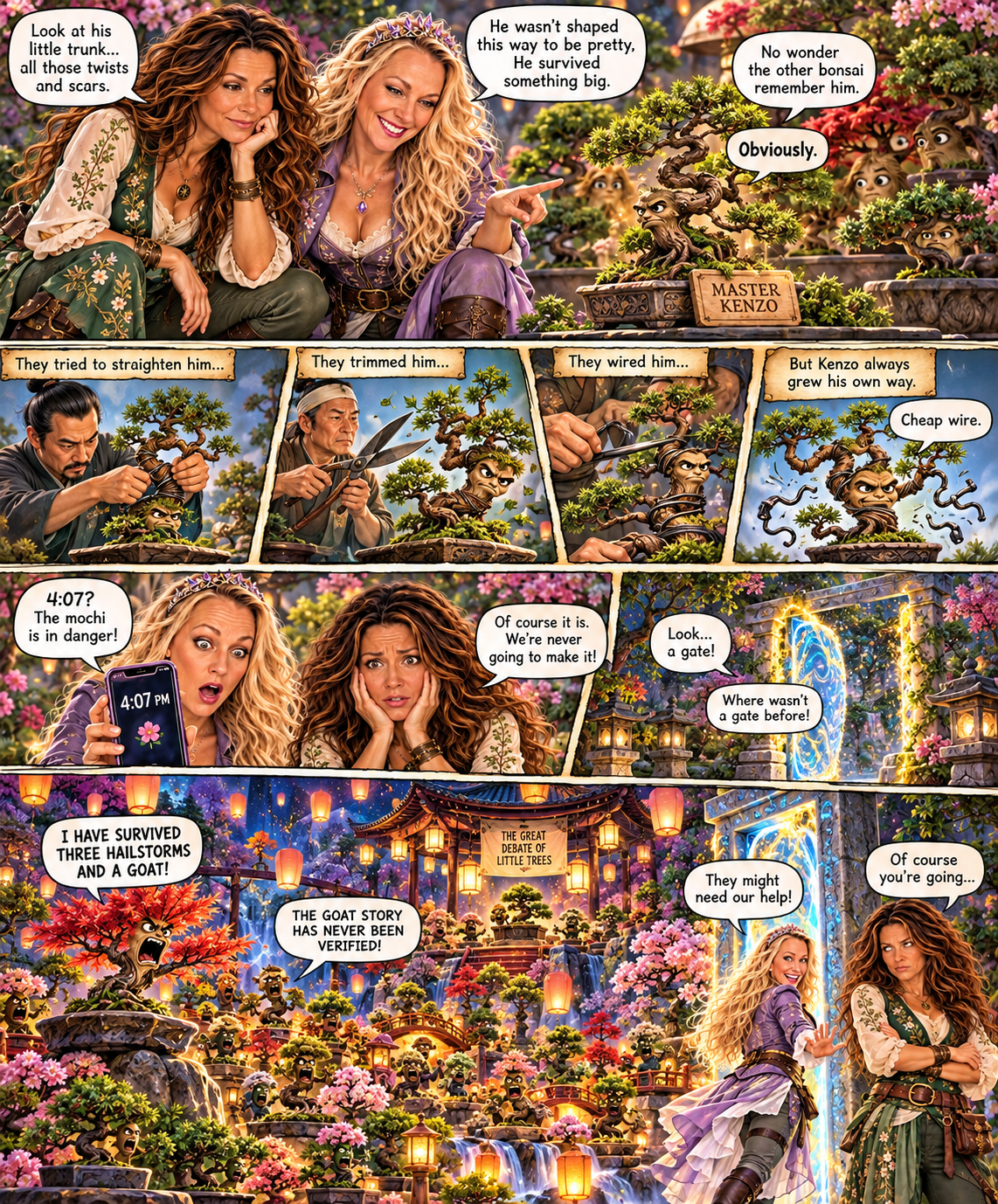
“He wasn’t shaped that way because somebody wanted him to look interesting.”

“No.”

Every bend in the little trunk suddenly made sense.

Storm damage.

Fire.

Regrowth.

Years of being cut back.

Years of surviving.

The cherry bonsai whispered:

“He never tells that part.”

The maple said:

“He says it sounds dramatic.”

Master Kenzo grumbled.

“It is dramatic.”

“You were on fire,” I said.

“A minor inconvenience.”

“YOU WERE A GIANT TREE IN A BURNING CITY.”

“I’ve had worse Tuesdays.”

I liked him.

Immediately.

Tara crouched beside him.

“So that’s why the other bonsai remember you.”

Master Kenzo’s tiny branches shifted.

The pine answered for him.

“No.”

We both looked over.

The pine continued.

“We remember him because after the fire, when he was only a cutting, he refused to grow as the gardeners expected.”

The juniper laughed.

“They tried to straighten him.”

“He bent.”

“They trimmed him.”

“He grew sideways.”

“They tied him.”

“He broke the wire.”

Master Kenzo sounded pleased.

“It was cheap wire.”

The cherry tree whispered:

“They wanted perfection.”

The maple finished:

“Kenzo preferred survival.”

For once, Tara had nothing sarcastic to say.

Neither did I.

The lesson was annoyingly beautiful.

Which meant the Mystery House was about to ruin it.

A bell chimed.

Four times.

Tara’s eyes widened.

“No.”

I grabbed my phone.

4:07 PM.

I stared at her.

“The mochi.”

“Maybe they’ll hold our table.”

Another bell rang.

Then another.

From somewhere deep inside the garden came the sound of dozens of tiny voices shouting.

Master Kenzo sighed.

“Oh dear.”

Tara slowly turned.

“What?”

The bonsai looked toward the far end of the garden.

A stone gate had appeared where no gate had been before.

Beyond it glowed hundreds of lanterns.

And beneath those lanterns—

Hundreds of bonsai.

Arguing.

Shouting.

Waving branches.

One tiny maple was standing on a rock screaming:

“I HAVE SURVIVED THREE HAILSTORMS AND A GOAT!”

Another yelled:

“THE GOAT STORY HAS NEVER BEEN VERIFIED!”

A flowering bonsai shouted:

“ORDER! ORDER!”

Master Kenzo groaned.

“The annual debate.”

I looked at Tara.

“No.”

She looked at the magical gate.

Then at me.

Then at the clock.

Then back at the gate.

“DeNae…”

“No.”

“They might need help.”

“No.”

“There could be a mystery.”

“No.”

Master Kenzo said:

“Someone has stolen the First Lantern.”

I closed my eyes.

Of course they had.

Tara smiled.

I pointed at her.

“Don’t.”

She smiled wider.

“Absolutely not.”

She stood.

“We’ll be quick.”

I stared at her.

Behind us, somewhere very far away, six varieties of mochi were disappearing from our lives.

And because apparently I have learned nothing from every adventure we have ever had—

I followed her through the gate.

🌿✨ To be continued…

https://upforme.ru/uploads/0019/3c/8c/7246/39449.png
https://upforme.ru/uploads/0019/3c/8c/7246/879921.png
https://upforme.ru/uploads/0019/3c/8c/7246/931340.png

Отредактировано DeNae (Сегодня 04:21:19)

Подпись автора

DeNae 🇺🇸 67b526

Guild: Tagalong

0

1580

gallery

🌿🍃 THE GREAT DEBATE OF LITTLE TREES
PART TWO — Tara: The Bonsai Have Formed a Government

In my defense, when a magical bonsai tells you someone has stolen the First Lantern, you investigate.

That is simply responsible citizenship.

DeNae disagreed.

DeNae’s position was that responsible citizens keep their four o’clock Lantern Tea reservations.

She mentioned the mochi seven times while we walked through the glowing stone gate.

Eight if you count:

“I hope the thief CHOKES on one.”

Which felt excessive.

The other side of the gate was astonishing.

The Japanese Garden stretched farther than it possibly could in the real world.

Hundreds of tiny trees filled terraces carved into a moonlit hillside.

Paper lanterns floated in the air without strings.

Little streams ran uphill.

Koi drifted through the sky.

Not jumped.

Drifted.

A large orange one floated past DeNae’s head.

She ducked.

“No.”

“What?”

“I am not acknowledging airborne fish.”

“It was beautiful.”

“It was a carp with no respect for gravity.”

Fair.

At the center of the garden stood a circular pavilion.

Inside it—

Chaos.

Absolute botanical chaos.

Hundreds of bonsai were shouting.

Branches waved.

Leaves fluttered.

Tiny blossoms flew through the air.

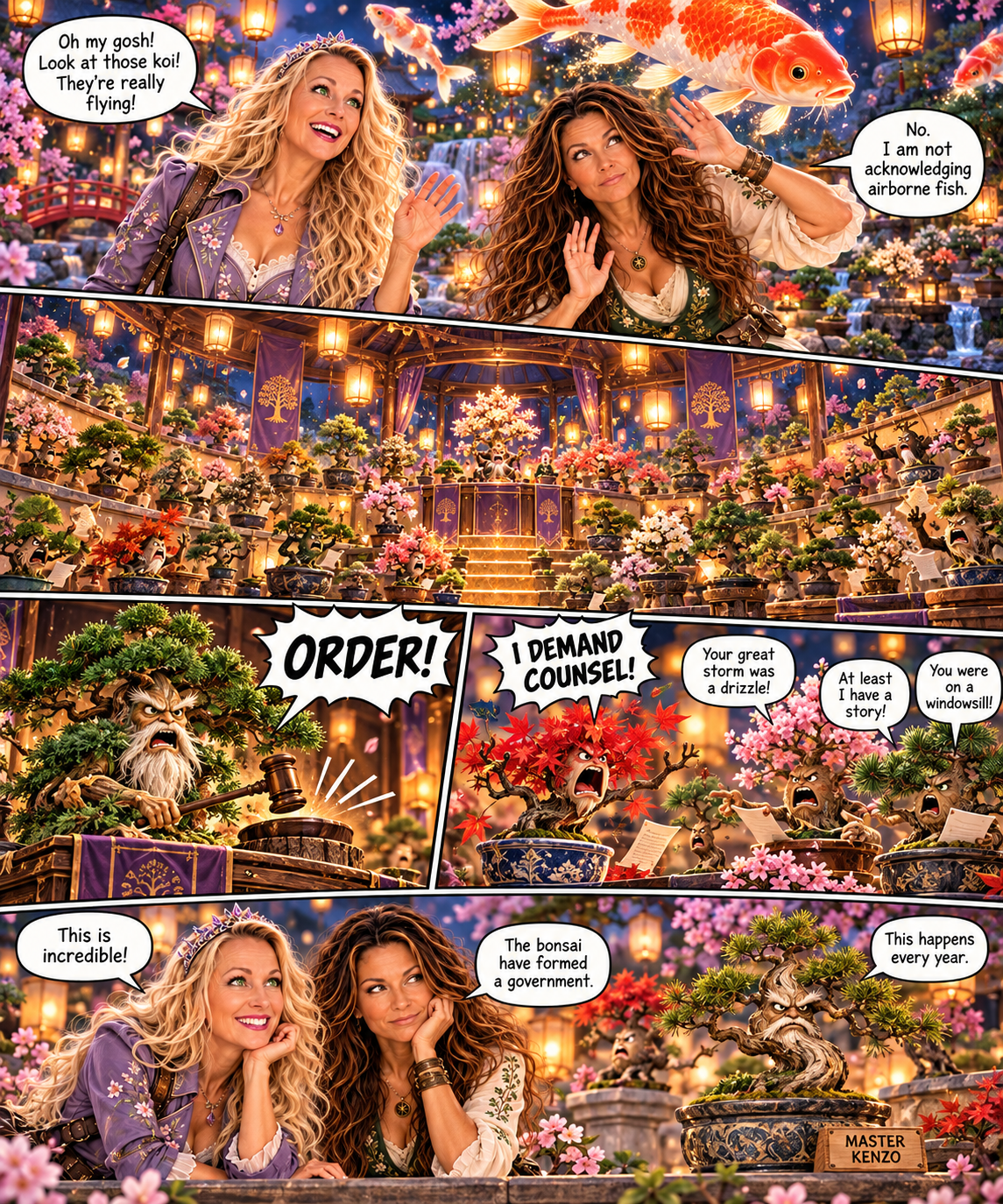
Someone had fashioned a miniature wooden gavel, which a cedar tree was repeatedly banging against a stone.

“ORDER!”

Nobody listened.

“ORDER!”

A little pine yelled:

“YOUR GREAT STORM WAS A DRIZZLE!”

A maple shouted:

“AT LEAST I HAVE A STORY!”

The cedar hammered harder.

“ORDER!”

DeNae looked at me.

“The bonsai have formed a government.”

“Apparently.”

“I’m going back.”

Master Kenzo blocked her path.

Which would have been more intimidating if he weren’t fifteen inches tall.

“The gate is closed until the First Lantern is returned.”

DeNae slowly looked down at him.

“You’re kidding.”

“I rarely kid.”

“You said we could leave.”

“I said no such thing.”

She pointed at me.

“This is why I establish boundaries.”

I whispered, “He’s technically right.”

“Not helping.”

⸻

The First Lantern, we learned, was older than every tree in the garden.

Which seemed questionable because I was pretty sure lanterns did not usually outlive trees, but this was also a place with flying koi and argumentative shrubbery, so I adjusted my expectations.

Each year, the Lantern was lit before the Great Debate.

Its flame allowed every bonsai to share one memory from its past.

That was how they told their stories.

Without it, nobody could prove anything.

Which explained the shouting.

A flowering plum tree was currently claiming she had once advised an emperor.

A juniper yelled:

“YOU WERE ON A WINDOWSILL!”

“THE EMPEROR HAD WINDOWS!”

“That proves NOTHING!”

The cedar slammed his gavel.

I leaned toward DeNae.

“I love this.”

“I know.”

“Can we keep one?”

“No.”

⸻

We examined the empty pedestal where the First Lantern had stood.

No footprints.

No broken branches.

No sign of forced entry.

Just three things.

A single red maple leaf.

A piece of silver wire.

And a drop of water.

DeNae picked up the wire.

“Bonsai wire.”

“Used to shape branches.”

Master Kenzo rustled.

“Yes.”

I studied the leaf.

It was bright red.

Too bright.

Almost glowing.

“Whose leaf?”

Immediately, fifty maple bonsai began yelling.

“NOT MINE!”

“I HAVE WITNESSES!”

“I WAS PRUNING!”

“I WAS ASLEEP!”

A tiny maple in the back shouted:

“I DEMAND COUNSEL!”

DeNae stared at me.

“They’ve watched too much television.”

One tiny tree near the pavilion quietly turned away.

I noticed.

So did Kenzo.

It was a strange little bonsai.

Smaller than the others.

Its trunk was pale and scarred.

Only three branches grew from one side.

And instead of standing proudly in an ornate ceramic pot like the others, it lived in a plain cracked bowl.

“What’s his name?” I whispered.

Master Kenzo hesitated.

“Ren.”

Ren heard us.

“I didn’t take it.”

DeNae walked toward him.

“We didn’t say you did.”

“You were thinking it.”

“I was thinking about dumplings.”

True.

I crouched beside Ren.

One of his branches was wrapped in silver wire.

Fresh wire.

But his leaves were green.

Not red.

“Where were you when the lantern disappeared?”

Ren’s tiny branches drooped.

“Outside.”

“Where?”

“Near the old bridge.”

Master Kenzo said quietly:

“Nothing grows beyond the old bridge.”

Ren didn’t answer.

Interesting.

Very interesting.

⸻

We followed Ren.

Past the lantern terraces.

Past the floating koi.

Past a bamboo grove where every stalk whispered different directions just to be annoying.

“Left.”

“Right.”

“Left.”

“Definitely right.”

“Turn around.”

“Ask for directions.”

DeNae yelled:

“WE DID!”

The bamboo laughed.

Eventually we reached the old bridge.

It crossed a narrow stream disappearing beneath thick mist.

On the opposite side was darkness.

No trees.

No lanterns.

Nothing.

Ren stopped.

“I come here sometimes.”

“Why?” I asked.

He hesitated.

“Because nobody argues here.”

Reasonable.

Then something glowed in the fog.

Red.

The maple leaf in my hand began to shine.

DeNae noticed.

“Well, that seems important.”

We crossed the bridge.

At the other side, we found a path that shouldn’t exist.

Broken lanterns lined it.

Old ones.

Dozens.

Maybe hundreds.

Each covered in moss.

And at the very end stood a stone basin filled with water.

Floating inside it—

The First Lantern.

DeNae folded her arms.

“Ren.”

“I DIDN’T PUT IT THERE!”

For once, I believed the tiny tree immediately.

Because the water around the lantern had begun moving.

Against the wind.

It spiraled around the stone basin.

Faster.

Faster.

Then rose into the air.

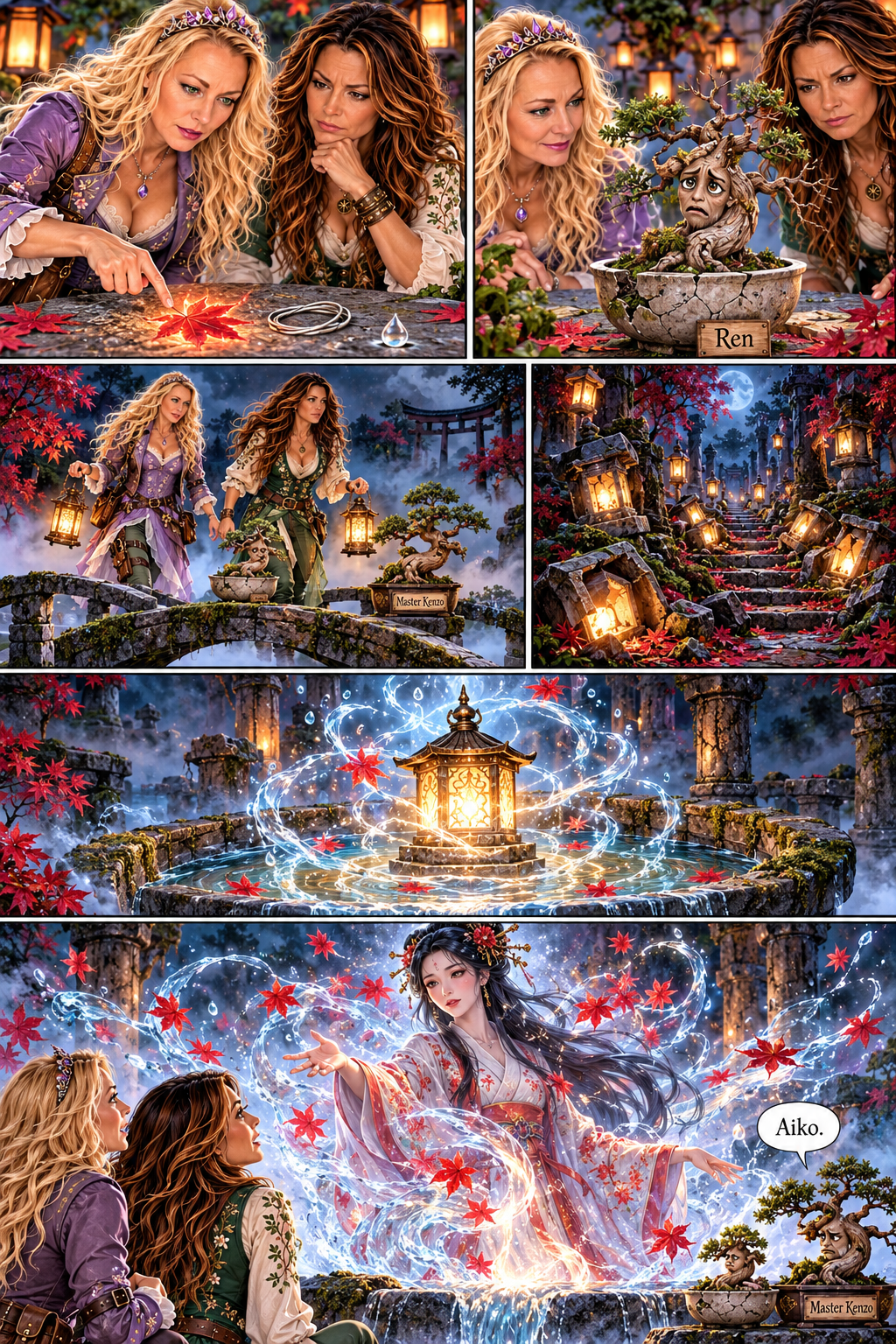
A woman stepped out of it.

Not exactly a woman.

More like the memory of one.

Her robes flowed like water.

Her long hair drifted around her shoulders.

Red maple leaves circled her feet.

Every bonsai went completely silent.

Even DeNae.

Which was impressive.

The spirit looked at Ren.

Then at Master Kenzo.

“You forgot.”

Kenzo’s branches stiffened.

“I forget very little.”

“You forgot me.”

Silence.

Then Kenzo whispered:

“Aiko.”

Ohhhhhhh.

Mystery.

⸻

Aiko had been the gardener’s daughter.

The same gardener we had seen centuries ago.

The man who saved Kenzo’s cutting from the fire.

Afterward, when Kenzo was little more than one surviving branch planted in a pot, Aiko had cared for him.

She watered him.

Protected him.

Talked to him.

And, apparently, argued with him constantly.

Kenzo claimed she was stubborn.

Aiko claimed he was impossible.

I believed both.

“She refused to shape me,” Kenzo said.

Aiko smiled.

“Everyone else was trying to make you beautiful.”

“You said I already was.”

“You were hideous.”

DeNae snorted.

I elbowed her.

Aiko continued.

“I said you were alive.”

There it was.

The whole story.

Kenzo had become famous because he refused to grow perfectly.

Other bonsai remembered him because he survived what should have destroyed him.

But there was another reason.

After Aiko died, Kenzo had started the Great Debate.

Not because he wanted trees competing over which story mattered most.

He wanted every tree to tell its story.

Because Aiko had taught him that survival looked different for everyone.

Beauty looked different.

Strength looked different.

And no tree should be judged against another tree’s shape.

Somehow, over hundreds of years, the bonsai had forgotten the point.

The storytelling became boasting.

The memories became competition.

The Great Debate became—

Well.

The Great Screaming Match of Little Trees.

Aiko had taken the Lantern.

Not to steal it.

To remind them why it existed.

Master Kenzo was quiet for a long time.

Then he muttered:

“I may have become slightly distracted.”

Aiko raised an eyebrow.

“Slightly?”

“A century or two.”

“Kenzo.”

“Three.”

DeNae whispered:

“I love her.”

So did I.

⸻

We carried the First Lantern back.

Technically DeNae carried it because I tried first and nearly dropped it when a koi floated through my hair.

There are limits.

The entire bonsai assembly fell silent when Aiko entered the pavilion.

Then she placed the lantern on its pedestal.

The flame ignited.

Gold.

Warm.

Soft.

One by one, the bonsai stopped arguing.

The flowering plum whispered:

“I never advised an emperor.”

The juniper said:

“We know.”

“I was near an emperor.”

“You were in a courtyard.”

“He walked past.”

“That counts a little.”

The pine cleared his branches.

“My Great Storm…”

Everyone groaned.

He continued:

“…was mostly rain.”

The pavilion erupted in laughter.

Even the trees.

Especially the trees.

Master Kenzo moved to the center.

His crooked little trunk looked completely ordinary among hundreds of beautiful specimens.

Yet every tree turned toward him.

“I was once tall,” he said.

“I survived fire.”

“I lost almost everything.”

“I grew again.”

He paused.

“And when gardeners tried to make me straight…”

Aiko said:

“You refused.”

Kenzo’s branches rustled.

“I preferred my own direction.”

I smiled.

There it was.

That was his character.

Stubborn.

Dry.

Proud.

Funny when he didn’t mean to be.

And completely unwilling to let anyone else decide what shape his life should take.

That was why they remembered him.

Not because he was the prettiest bonsai.

Not because he was the oldest.

Not even because he survived the fire.

They remembered Kenzo because after surviving it, he taught generations of little trees that being changed by hardship did not make their story less beautiful.

And because, apparently, he once broke seventeen shaping wires in a single summer.

“Eighteen,” Kenzo corrected me.

Of course.

⸻

The garden began glowing.

The magical terraces faded.

The koi floated gently back into their pond.

The stone gate appeared.

DeNae grabbed my arm.

“FOOD.”

“Yes.”

“MOVE.”

We ran.

Through the gate.

Down the path.

Past the bonsai terrace.

Across the bridge.

Around the pond.

Out of the Japanese Garden.

I checked my phone.

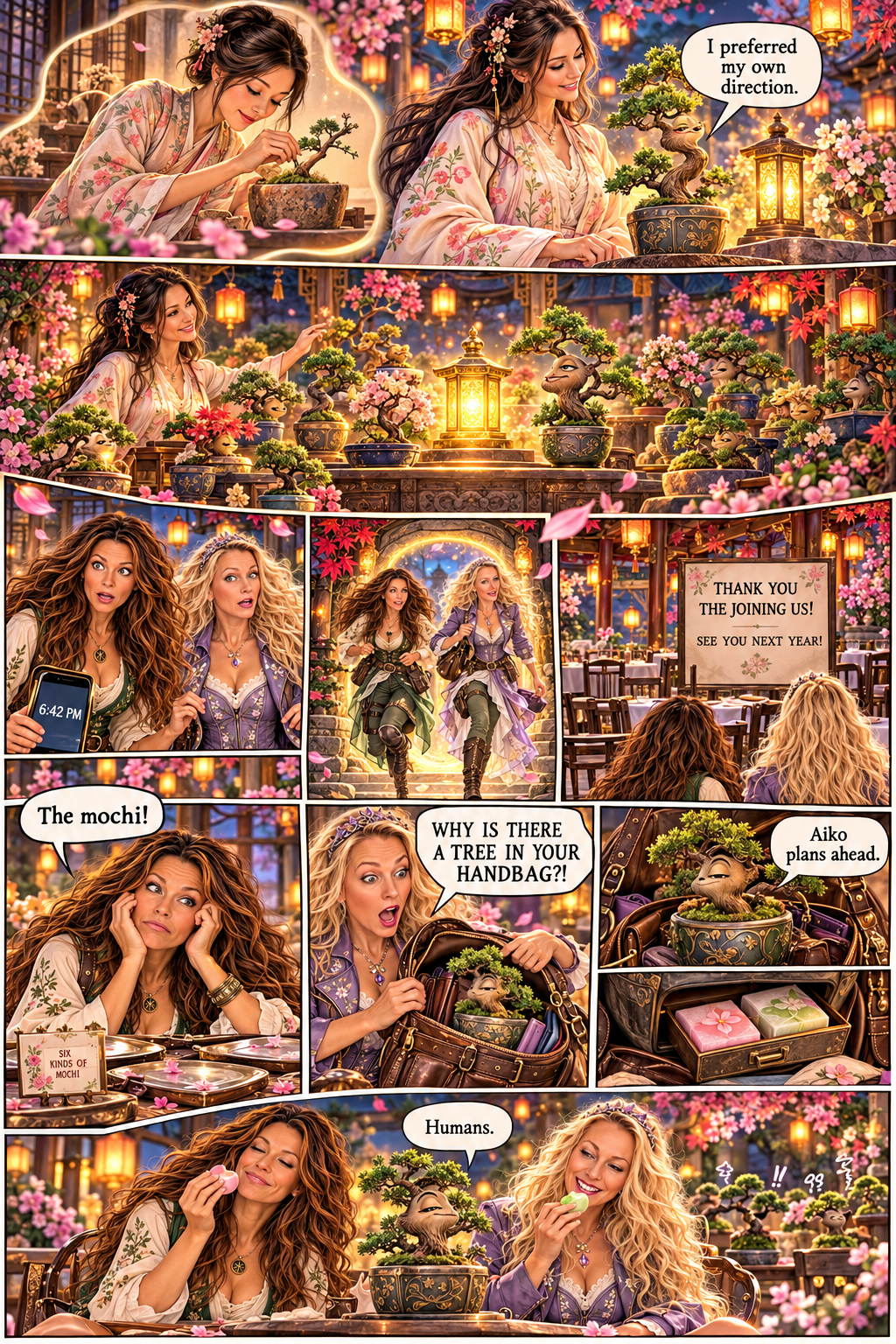
6:42 PM.

DeNae stopped running.

I nearly collided with her.

“No.”

I looked toward the Lantern Tea pavilion.

Empty.

Tables cleared.

Lanterns extinguished.

Not a dumpling in sight.

A little sign stood beside the entrance.

THANK YOU FOR JOINING US!
SEE YOU NEXT YEAR!

DeNae read it.

Then slowly turned toward me.

I prepared myself.

“You said twenty minutes.”

“I know.”

“We missed the tea.”

“I know.”

“We missed the dumplings.”

“I know.”

“The honey cakes.”

“Yes.”

Her voice dropped.

“The six kinds of mochi.”

I considered running.

Then a tiny voice came from inside my purse.

“Technically there were eight varieties.”

I froze.

DeNae froze.

Very slowly, I opened my purse.

Inside sat Master Kenzo.

Pot and all.

I screamed.

DeNae yelled:

“WHY IS THERE A TREE IN YOUR HANDBAG?!”

“I DON’T KNOW!”

Kenzo rustled.

“Aiko suggested I broaden my horizons.”

“You live in the Japanese Garden!”

“I’ve seen it.”

“You can’t come home with me!”

“That remains to be seen.”

DeNae bent over laughing.

I stared at the tiny ancient tree sitting beside my wallet.

“You are going back.”

“Tomorrow.”

“Tonight.”

“I dislike traveling after dark.”

“You just traveled through time!”

“I was younger then.”

DeNae was now laughing so hard she had tears in her eyes.

I pointed at her.

“This is not funny.”

“It absolutely is.”

Master Kenzo cleared his branches.

“There is, however, something you may find useful.”

He tapped one root against the side of his pot.

A small compartment opened beneath it.

Inside were two perfectly wrapped mochi.

DeNae stopped laughing.

We stared.

Kenzo said:

“Aiko plans ahead.”

I picked one up.

DeNae picked up the other.

We took one bite.

Then looked at each other.

“Oh.”

“Ohhhhh.”

Master Kenzo sounded smug.

“Worth missing the tea?”

“No,” DeNae said immediately.

I nodded.

“Absolutely not.”

The tree sighed.

“Humans.”

And somewhere behind us, deep inside the Japanese Garden, hundreds of tiny trees began arguing over which of them had the best dessert.

We did not turn around.

We had learned at least one thing.

🌿🍃✨ THE END
https://upforme.ru/uploads/0019/3c/8c/7190/287810.png
https://upforme.ru/uploads/0019/3c/8c/7190/794281.png
https://upforme.ru/uploads/0019/3c/8c/7190/805154.png

Отредактировано Tara 031cde (Сегодня 04:23:09)

Подпись автора

Tara 🇺🇸 031cde
Guild: Double D’s

0

Быстрый ответ

Напишите ваше сообщение и нажмите «Отправить»


Вы здесь » Загадочный дом - Фан клуб » 🤗 Поиграем 🎉 » ПРИКЛЮЧЕНИЯ